
Supermarkets and shops
Refrigerated display cases and cold rooms run all year round. Their heat goes to hot water and heating the sales floor.
A refrigeration machine removes heat from cold rooms and display cases and rejects it outdoors through the condenser, together with the energy consumed by the compressor. Heat recovery puts this heat to work: it heats domestic hot water and heating water, so the gas boiler or electric water heater runs less.
The heat exchanger is installed in the refrigerant circuit between the compressor and the condenser, where the hot gas is at its highest temperature. The superheated gas brings the water up to a high temperature, while the heat of condensation does most of the preheating. The water is collected in a storage tank, and the condenser is unloaded and runs at a lighter duty.
When only some of the compressors in the rack are running, there is less heat and the water is cooler. A pump with a three-way valve switches the system to bypass and keeps the outlet temperature stable. The existing water heater stays in place and only tops up the water when the refrigeration heat is not enough.
There is partial recovery, which uses only the superheat in the discharge line, and full recovery, which also captures the heat of condensation. The heat goes to domestic hot water, low-temperature heating or preheating supply air to +30…+40 °C.
In 2025 the country consumed about 71 billion kWh of electricity. According to the estimate we made for Belarus, about 35% of electricity goes to refrigeration machines. If this model is applied to Uzbekistan, their heat, which is now rejected outdoors, amounts to roughly 2 GW, or about 18 billion kWh of heat a year. These are secondary energy resources that have already been paid for.
Refrigerated display cases and cold rooms run all year round. Their heat goes to hot water and heating the sales floor.
High hot water demand for washing up and cooking coincides with the operation of the refrigeration equipment.
Equipment washing and production processes need a lot of hot water, while cooling is needed all the time.
They combine cold rooms with a need for warm water for sanitation.
Milk coolers give off heat that warms water for cleaning the milking equipment.
Preheating water with heat from refrigeration units, with legionella protection.
We work with equipment from the German manufacturer DK-Kälteanlagen for systems from 5 to 500 kW. Companies of our group are an official DK partner and have been installing its systems since 2013.
For individual condensing units and small racks with a discharge line up to 35 mm. The water in the tank stratifies by temperature, so no pump is needed.
For large refrigeration racks with a discharge line up to 108 mm. A pump and a three-way valve maintain the temperature whatever the number of compressors running.
Refrigerant and water are separated by two walls (EN 1717). Legionella protection is included: the reheat cycle is skipped if the water has already been heated by the refrigeration system.
Finned copper heat exchangers in the storage tank. Flushing connections allow the heat exchanger to be cleaned without removing it.
| Site | Heat use and result |
|---|---|
| Minsk, 2013 | Supply air preheating: 22.9 kW, 45.8 Gcal of heat a year |
| Gomel, 2014, supermarket | Heating and ventilation: 45 kW in winter and up to 140 kW in summer, replaces about 18,300 m³ of gas a year |
| Minsk, 2015 | Domestic hot water: 32.2 kW, 1,000 l tank, 1,387 m³ of hot water and 47.45 Gcal a year |
| Minsk, 2021–2022 | Domestic hot water: 36 kW refrigeration machine, 547.5 m³ of water and 21.9 Gcal a year |
| Minsk, 2022, shop | Domestic hot water with online monitoring: measured over 151 days: 39 Gcal (45,395 kWh), 1,150 m³ of hot water, about 5,100 m³ of gas |
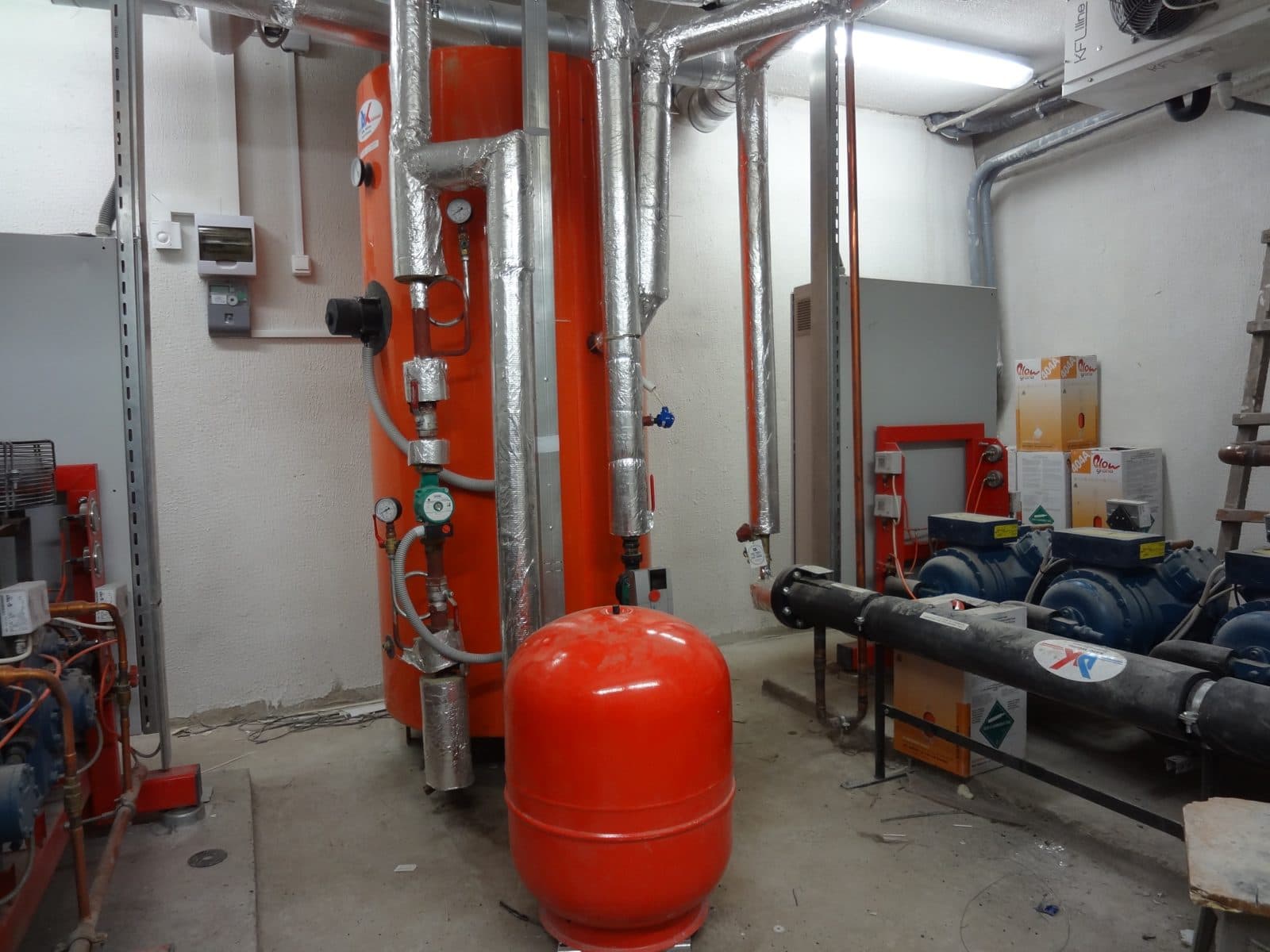
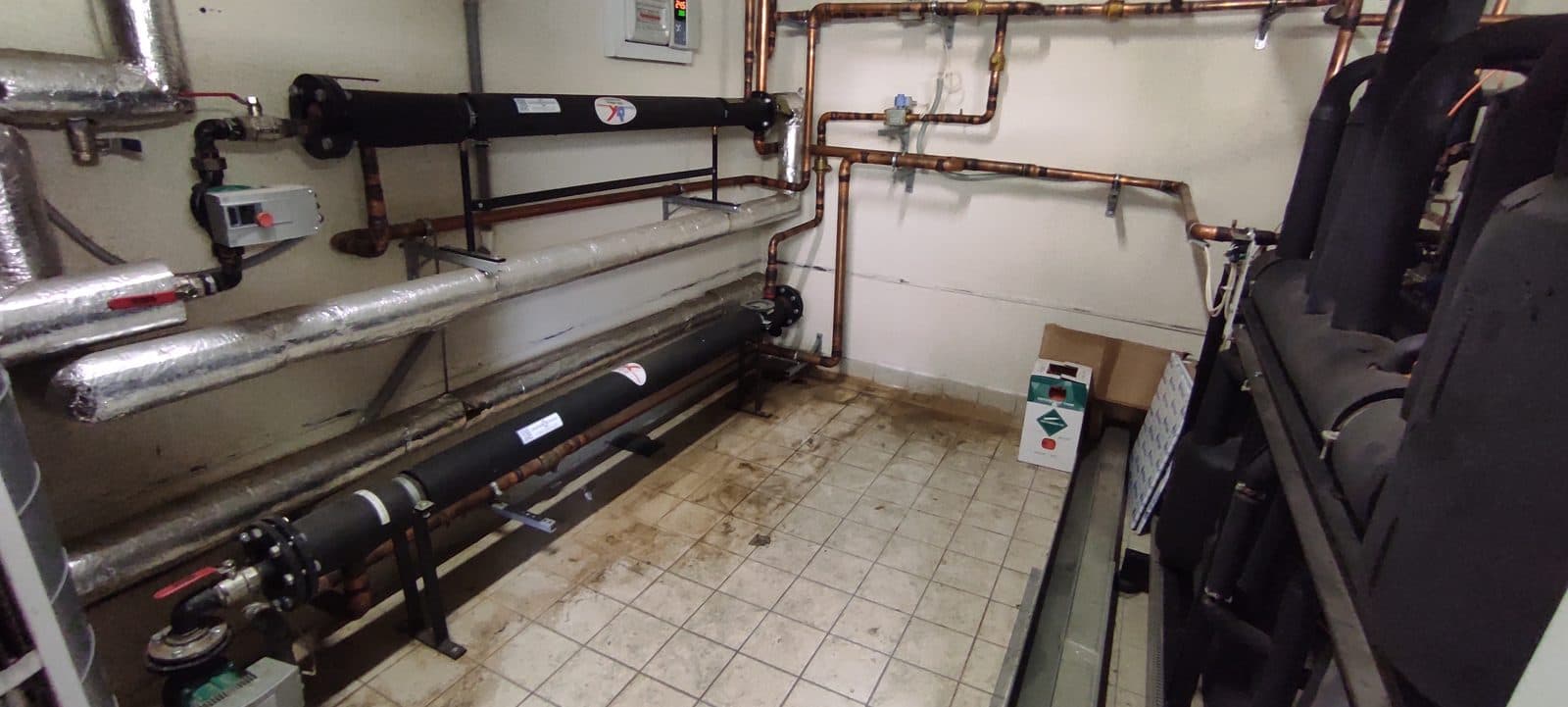
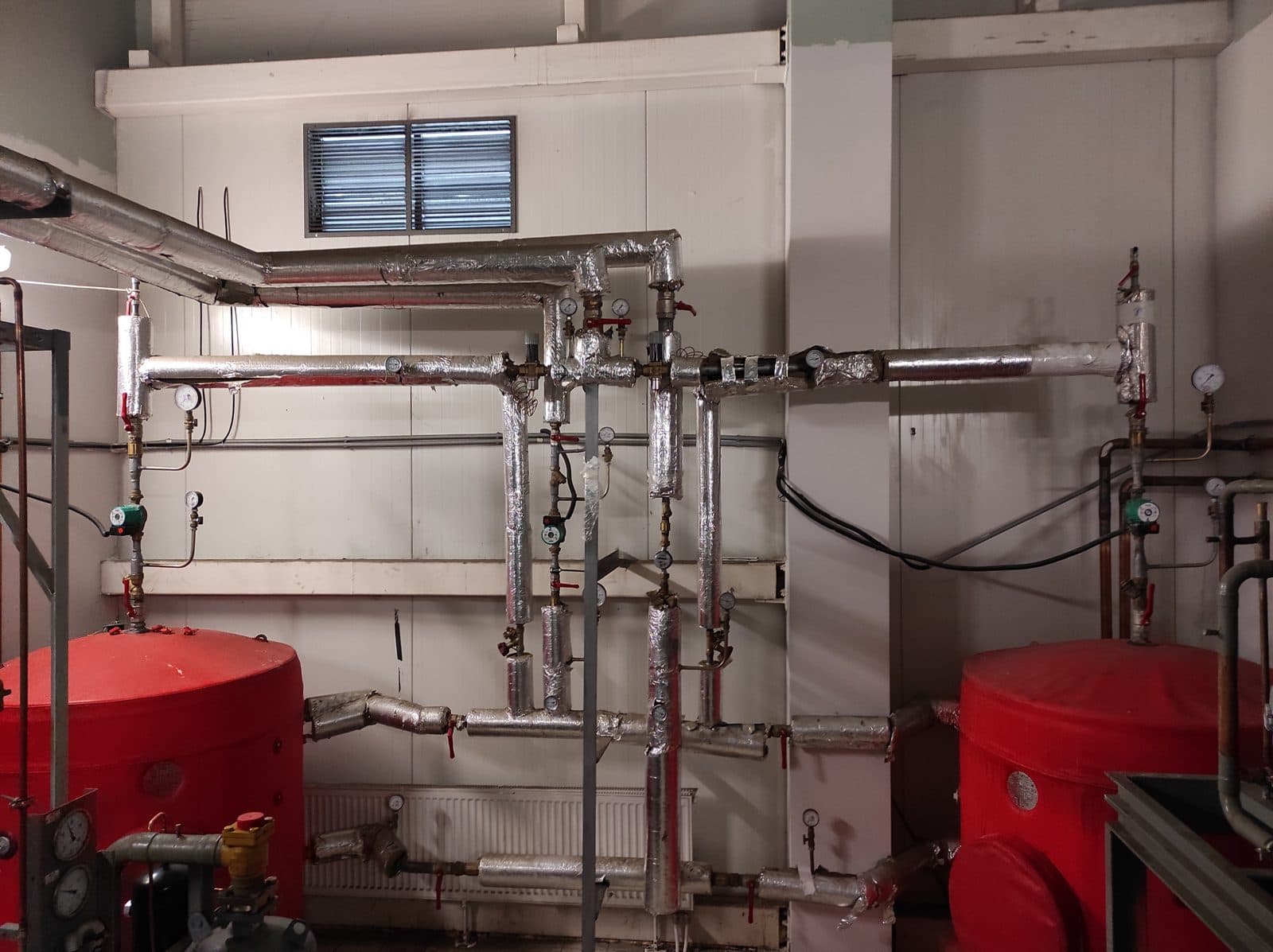
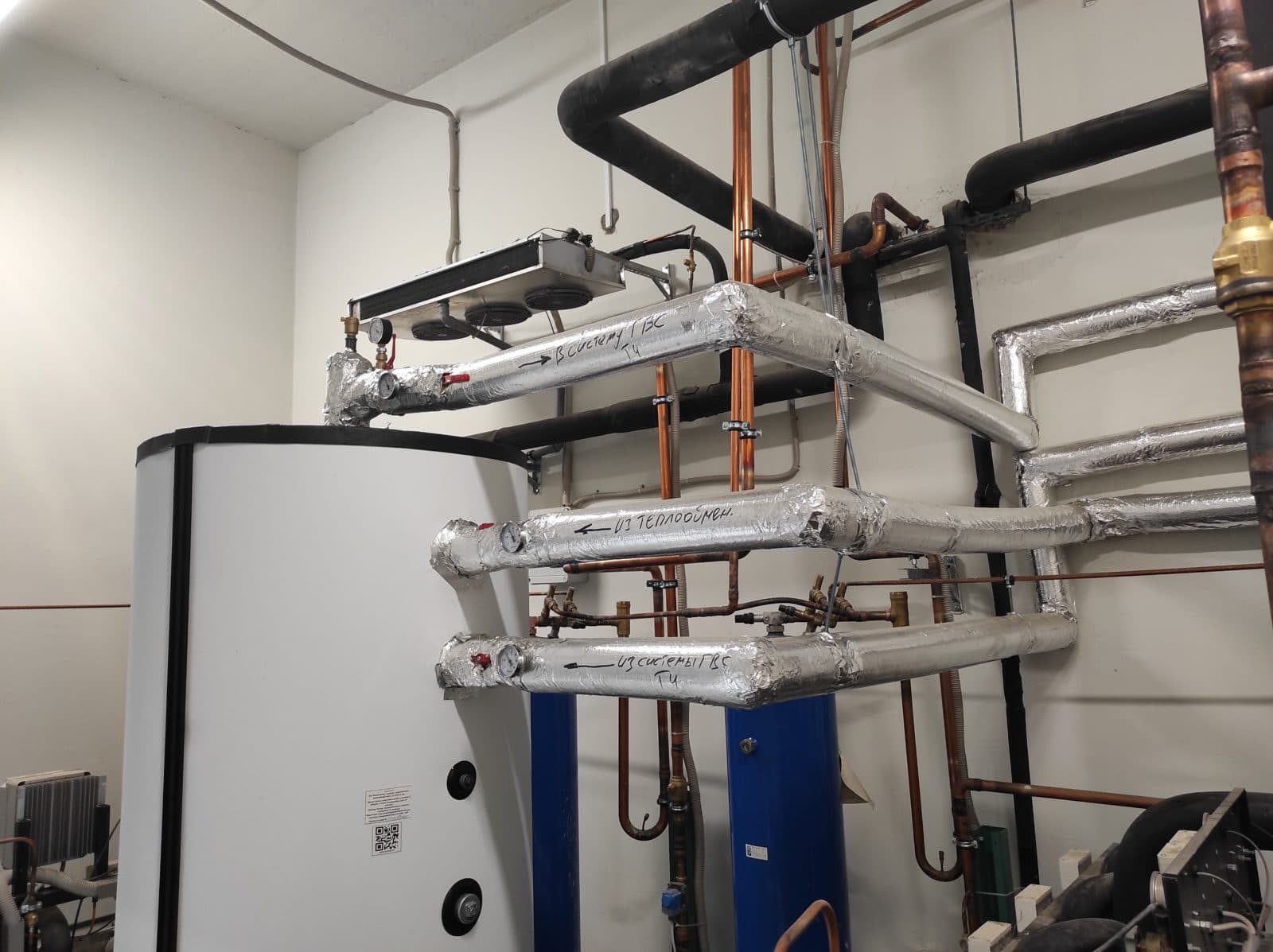
Heat meters and temperature sensors send data through automation and dispatch panels to a database and a web dashboard. It shows how much heat has been produced, how much water has been heated and the resulting total TER: the ratio of useful cooling and heat to the electricity consumed (TER = EER + COP).
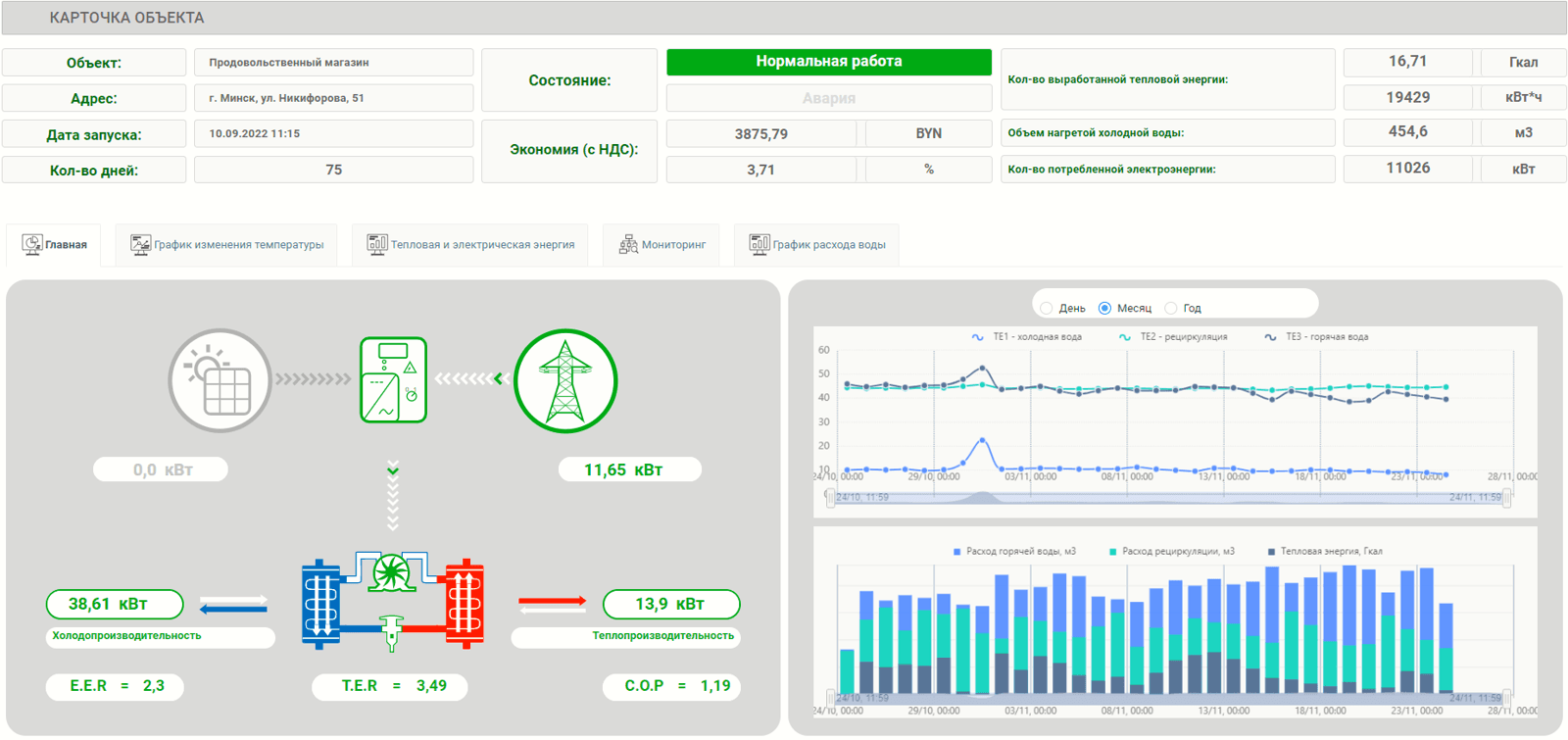
Monitoring also matters for maintenance. At one site, scale was found in the heat exchangers after six years of operation, so we include water treatment and flushing connections in the design, and any drop in heat output shows on the dashboard straight away. At another site, monitoring showed that the buffer tank was too small: the water overheated at night and the temperature dropped during the day. Such mistakes only show up in the data, so we size the tank from the daily profile of water use and refrigeration operation.
A facility uses 2 m³ of hot water a day, 300 days a year, heated from 10 to 50 °C. That is about 27,907 kWh of heat a year. If all of this heat comes from the refrigeration equipment, the water no longer needs to be heated:
| Instead of a gas boiler (90% efficiency) | 3,510 m³ of gas, about 6,268,329 UZS a year |
|---|---|
| Instead of an electric water heater | 27,907 kWh, about 27,408,254 UZS a year |
Tariffs excluding VAT: gas 1,785.71 UZS/m³, electricity 982.14 UZS/kWh. How much heat your equipment actually delivers depends on its capacity and operating hours; we calculate this during the site survey. You can compare heating sources in the online calculator.
Supply and exhaust air handling units with plate and rotary heat exchangers recover heat from the exhaust air.
Heat exchangers and heat pumps extract heat from warm wastewater from showers, laundries and production.
Heat meters and sensors show the actual savings. This data feeds into ESG reporting and Project MRV.
Heat recovery does more than cut operating costs: it helps meet the national energy-saving policy (Presidential Decree PD-70, Cabinet of Ministers Resolutions No. 242 and No. 230). Saved gas reduces direct Scope 1 emissions, saved electricity reduces Scope 2, and heat metering provides data for reporting. Learn more in ESG and decarbonization.
Fill in the contact formFill in the contact form